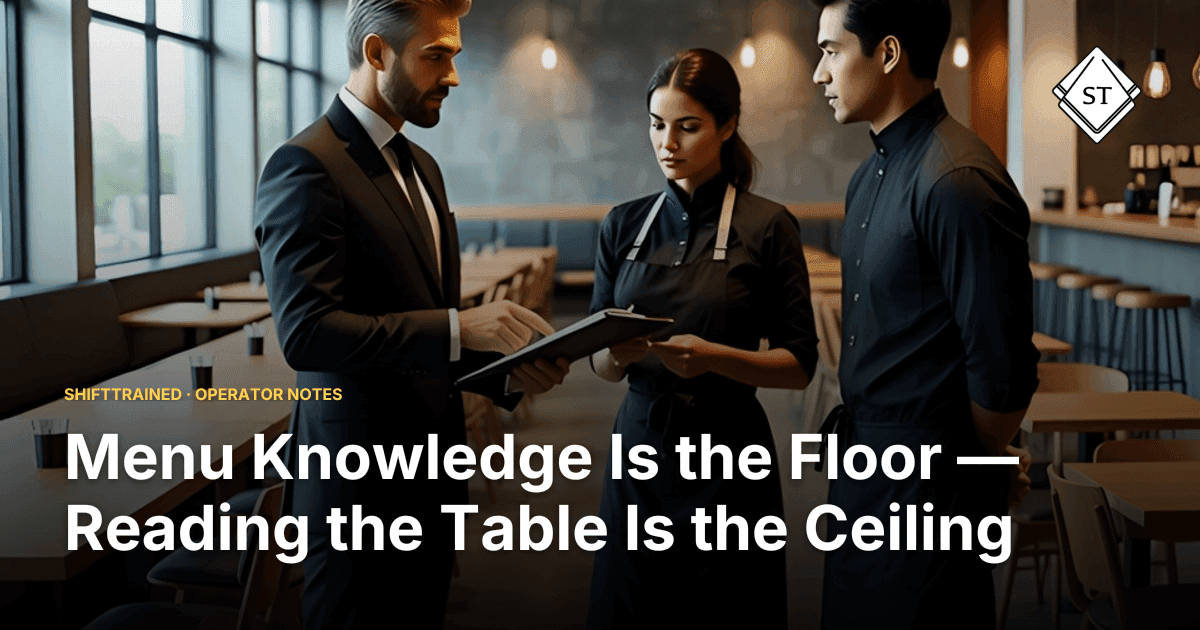
Menu Knowledge Is the Floor — Reading the Table Is the Ceiling

Hey Team!
There's a server on every floor you've worked who knows the menu inside and out. Rattles off ingredients, handles allergen questions without flinching, can describe a dish well enough to make you want to eat it right now. And that same server consistently leaves money on the table. Not because they don't know the food. Because they can't tell the difference between a table that wants to linger over dessert and a table that's been ready for the check for ten minutes.
I've watched this play out in my own places more times than I can count. You invest real time getting a server to product knowledge, you can see it working, and then you notice their check average is still flat. Or worse, you get a comment card about feeling rushed. Or about feeling ignored. Neither one is a menu problem. Both of them are a reading problem.
Here's where operators get confused. They treat menu knowledge and situational awareness like they're interchangeable. Like you can teach a new server to read a table the same week you're teaching them what's in the braise. You can't. And trying to do both at once usually means you do neither well.
Think about a jazz musician learning to improvise. Miles Davis didn't sit down and start riffing on his first day. He ran scales. He learned theory until it was automatic, until his fingers knew the intervals without his brain having to think about them. Only then could he actually listen to what the other players were doing and respond in real time. The music happened in the space that opened up once the fundamentals were locked in.
Serving works the same way. When a server is still mentally working through what's in a dish, they can't also be watching body language. They can't notice that the couple at table seven is leaning back, wine half full, no rush. They're too busy managing the information load in their own head. Their attention is pointed inward.
Product knowledge has to be automatic before situational awareness can even start. Once a server genuinely knows the menu cold, something frees up. Their eyes come up off the proverbial sheet music. They start actually seeing the room.
I've seen this happen. We had a server at Black Barrel Tavern who was sharp but green. First couple of weeks, he was technically solid, got the orders right, described things accurately, never got tripped up on ingredients. But he was on rails. He'd run the same sequence on every table regardless of what the table was showing him. Didn't matter if two people were in a sprint to make a show downtown or a group of four was halfway through a bottle of wine with nowhere to be. He'd run his script.
What changed wasn't another menu quiz. He already knew the menu. What changed was when we started doing what I'd call situational debriefs after his shifts. We'd talk through specific tables. Not "did you know the menu" but "what did that table tell you about where they were in their night?" Slowly the pattern recognition started building. He started asking questions like "that table by the window, they didn't really look at me when I came by the second time, is that usually a 'leave us alone' signal?" Yes. Usually it is.
That kind of learning only becomes possible once the mechanical stuff is out of the way. You can't coach improvisation to someone who's still trying to remember the scales.
The practical implication for operators is that these two things are a sequence, not a choice. You're not trading off one for the other. Menu training comes first, and it has to actually finish. Not "close enough" finish. Automatic finish. The test I'd use is simple: can your server describe the dish without hesitating, field a follow-up question about it, and still be looking at the guest the whole time? If their eyes go somewhere else while they're talking, they're still processing. It's not automatic yet.
Once it is, that's when you layer in the situational work. Read the table. Notice whether people are making eye contact with you or avoiding it. Notice who's talking and who's done. Notice the pace of the meal the guests themselves are setting. A table that ordered fast, ate fast, and has been stacking their own plates is not a dessert upsell. A table that's been at it for two hours and just ordered a third round is. These aren't tricks. They're just observations that a server can only make when their brain has room for them.
The menu is the floor. It's not optional, it's not good-enough-ish, it has to be solid. But a server standing on that floor looking at their shoes is still not serving at their ceiling. The ceiling is reading the room, matching the energy of the table, knowing when to come in and when to stay back. That's where the experience actually happens for the guest. That's where tips go up and complaints go down and people decide whether they're coming back.
One thing I'll say about how I approach this at ShiftTrained: the platform locks in the floor faster than any pre-shift meeting I've ever run. Staff quiz themselves on their phones, they get repetitions in, the knowledge becomes automatic quicker. That frees operators and managers to spend their coaching time on the ceiling stuff, the table-reading, the feel of the room, the things that can't be multiple-choiced.
Get the scales down first. Then teach the music.
Have a great day! — Terry Psaltakis
Your AI Restaurant Guy
For more on putting this into practice, see how ShiftTrained approaches menu training software.